
Niamey Hosted the National Forum of the Sahel Peace Initiative
24 June 2026
Two days of dialogue and commitment for lasting peace in Niger and the Sahel
Niamey, 24 June 2026 – The Hôtel Bravia in Niamey hosted the National Forum of the Sahel Peace Initiative (SPI) on 23 and 24 June 2026, organized by CADEV-Niger with the support of CRS, under the theme: “Let us raise our voices and unite our efforts for lasting peace in Niger and the Sahel.”
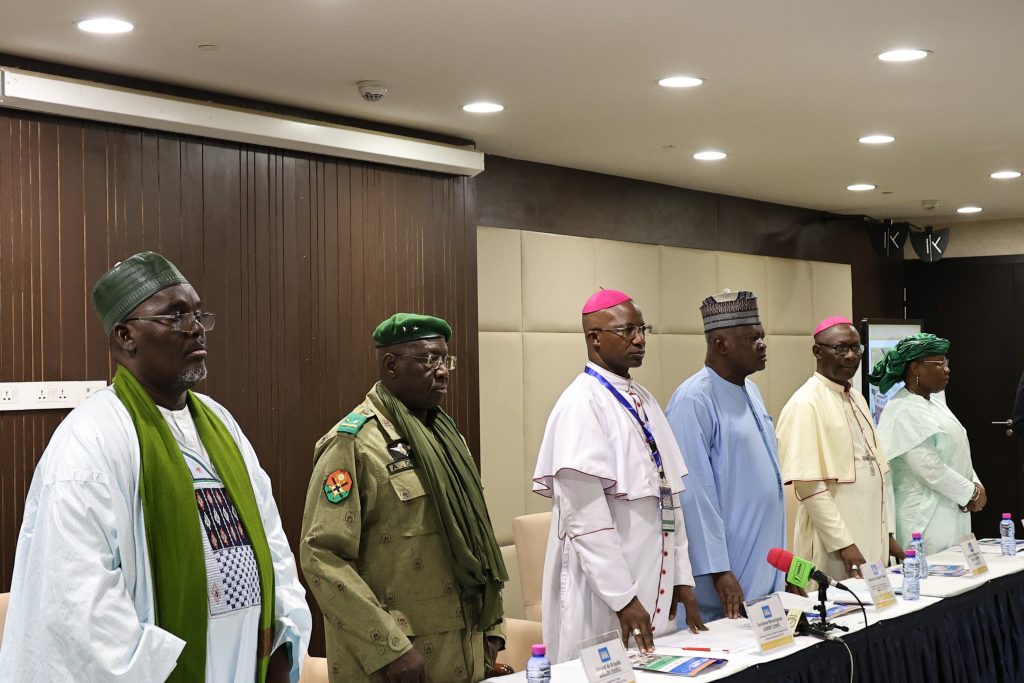
Held under the high patronage of the Minister of State, Minister of the Interior, Public Security and Territorial Administration, and of His Excellency Archbishop Laurent Lompo, Metropolitan Archbishop of Niamey and Chairman of the Sahel Peace Initiative (SPI) Working Group, the gathering brought together representatives of public institutions, administrative, religious and traditional authorities, the media, civil society organizations, technical and financial partners, as well as young people and women from different regions of the country.
The opening ceremony was chaired by the representative of the Minister of State, accompanied notably by His Excellency Archbishop Laurent Lompo, the Honourable Sheikh Barham Aboubacar, National Coordinator of the Inter- and Intra-Religious Dialogue Committee (CDIR), Brigadier General Diddili Amadou, Chairman of the High Authority for Peace Consolidation (HACP), as well as numerous national and international dignitaries.
A moment of reflection was observed in memory of the civilian and military victims of the recent terrorist attacks that struck Niger, notably those that took place in Niamey a few days earlier.
A Unanimous Call for Unity and Dialogue
In his address, Archbishop Laurent Lompo recalled that peace cannot be decreed but must be built every day through justice, solidarity, inclusion and dialogue. He placed particular emphasis on the need to invest in young people and to strengthen the role of women in peace processes.
For his part, the Honourable Sheikh Barham Aboubacar stressed that in Niger, religions are forces for unity rather than division. He called on religious leaders to remain builders of peace and to combat hate speech, violent extremism and any form of manipulation likely to weaken social cohesion.
The Chairman of the High Authority for Peace Consolidation, Brigadier General Diddili Amadou, stressed the need for coordinated responses to the security, social and economic challenges facing communities. He recalled that lasting peace requires the involvement of all stakeholders, particularly young people, women, religious and traditional leaders, as well as community organizations.
In the official address read on behalf of the Minister of State, the minister’s technical advisor, Mr. Alassane Seiboun, invited participants to make social cohesion, conflict prevention and community resilience national priorities. He reaffirmed the government’s readiness to support all initiatives that help preserve national unity and the country’s stability.
Discussions Focused on Solutions
The forum’s proceedings were structured around several thematic panels.
The first panel gave the floor to communities directly affected by violence, to gather their concerns, expectations and proposals.
The second panel allowed religious leaders and traditional chiefs to share their experiences and recommendations for strengthening interreligious dialogue and reconciliation.
The second day was devoted to the role of the media in promoting peace and citizenship. Participants stressed the responsibility of media professionals in combating disinformation, hate speech and community tensions.
A high-level round table then brought together technical and financial partners to discuss coordination, funding and the sustainability of peace consolidation initiatives.
On the sidelines of the proceedings, participants also visited exhibition stands run by internally displaced persons benefiting from income-generating activities. This initiative highlighted the economic resilience efforts of communities affected by crises and encouraged their empowerment.
Recommendations and a Collective Commitment
The forum’s final session was devoted to identifying priority actions and formulating recommendations for public authorities, religious organizations, the media, technical and financial partners, and community organizations.
Participants notably recommended:
Strengthening the economic empowerment of young people and women;
Supporting community mechanisms for conflict prevention and management;
Developing peace and citizenship education programmes;
Strengthening interreligious and intercultural dialogue;
Better coordination among the various peace actors;
Increased mobilization of resources for local social cohesion initiatives.
The proceedings concluded with remarks from the Honourable Sheikh Barham Aboubacar and His Excellency Archbishop Laurent Lompo, who called on participants to turn the forum’s recommendations into concrete actions for the benefit of communities.
At the end of these two days, a strong message emerged from the discussions: lasting peace in Niger and the Sahel can only be built through the collective, inclusive and ongoing mobilization of all of the nation’s active forces.
“Let us raise our voices and unite our efforts for lasting peace in Niger and the Sahel” — this was the call issued by participants at the close of the National Forum of the Sahel Peace Initiative.